 The
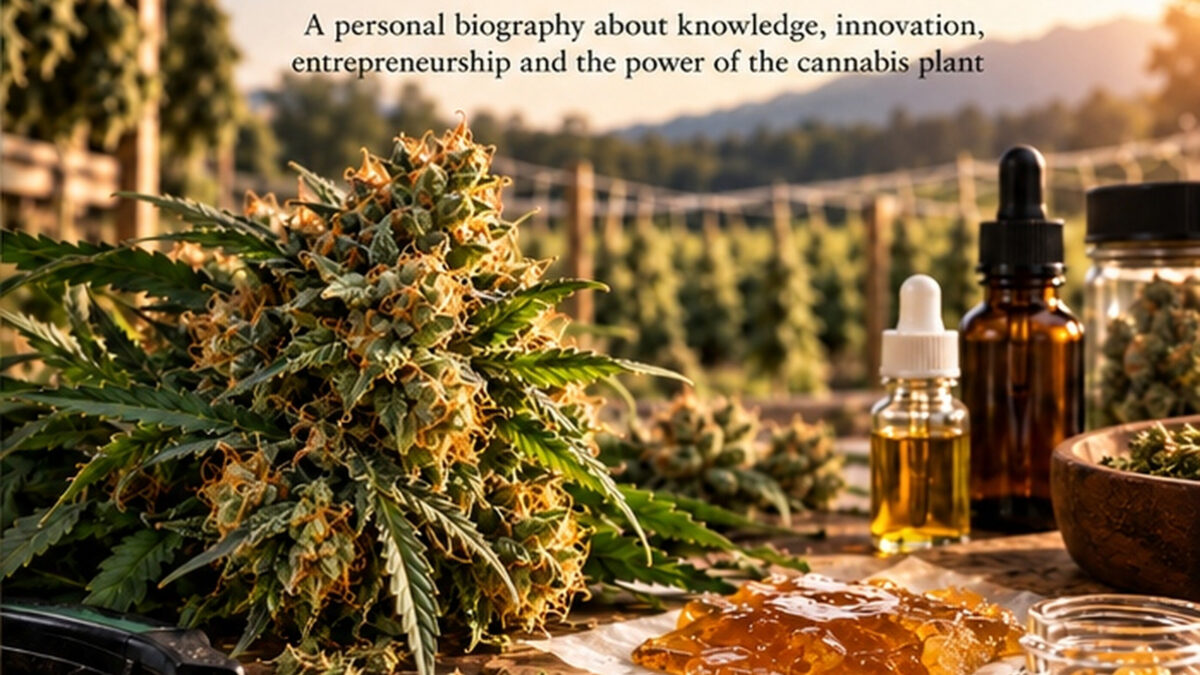
Disclosure: the author, Adelino Peterus Melo, sent us a free English EPUB review copy. He did not pay for this review, we made him no promises about the verdict, and we do not do link swaps. The buying link below is there for readers who want the book; it is not a reward for coverage.
The short version
My Way in Cannabis is a brisk, plain-spoken biography of a Dutch grower turned CBD entrepreneur turned hemp-materials and technology enthusiast. At roughly 8,000 words across 42 short chapters it reads in an evening. It is honest about being a personal account rather than a proof, and it is at its best when it describes what thirty years of watching plants teaches you. It is at its weakest where the stakes are highest: specific facts, dates, names and evidence are mostly missing. It is a memoir, not a manual and not a history of the industry.
What it is
The author was born in Rotterdam to a Dutch and Cape Verdean family. He says cannabis first entered his life as a memory from 1989, when he was four. At around twelve he began growing, and says he worked with the plant “almost continuously for approximately thirty years.” The book follows that road in twelve parts:
- Origins: family, culture and the first plants, including the early genetics he remembers best (Noorderlicht x Big Bud and Amnesia).
- Thirty years of learning: growing at several locations at once, eight years studying Ed Rosenthal’s work, and learning to “read” a plant.
- The hidden world: why growers stayed anonymous, a flooded underground bunker, the dangers of 1990s lighting and power, and an unexpected police visit.
- Nutrition and an organic vision: flushing, home-made organic experiments (milk, sugar, yeast, lime, banana peel) and his “seven principles”.
- Resin, extracts and CBD: ice hash, dab, the idea for a cold, oil-based CBD process, and a family illness around 2010 that changed his direction.
- cbdbiooil: his CBD brand, its cosmetics, lab analysis from around 2020 and partners in countries including the Netherlands, Italy, Spain, Germany, Switzerland, Bulgaria, China, Egypt and Dubai.
- Dubai: a long-running cooperation and a cosmetic CBD presentation at an expo.
- A changing industry: the campaign around Michael Thompson, and executives and investors moving into legal cannabis.
- When the business stalled: years of trouble with his municipal registration, which he says held back plans for a group of B.V. companies.
- Hemp materials: hemp concrete, hemp plastic and the bridge to a newer venture, Hemp-Tech NL.
- The next generation: his hopes for AI-assisted growing, robotics, new genetics (including gene editing “where this is possible within appropriate research and legal frameworks”) and legislation that keeps pace with science.
- What I want to pass on: reflections, and a note on his other book, The Cannabis Testament, which covers the plant itself.
What it is meant to represent
Melo’s stated aim is to pass on lessons from an era when cannabis knowledge travelled only by word of mouth. He says that secrecy meant “a great deal of practical knowledge never became public” and mistakes were repeated. The book is also, quite openly, the origin story behind his later companies and his current “evolution within an evolution” outlook: cannabis as biology, chemistry, culture, politics, health and industry at once.
He is careful to say what the book is not. The author’s statement describes it as “a biography, not a technical manual”, and says family names, sensitive documents and old growing locations are deliberately left out.
Two passages worth quoting
“I do not want to make anything larger than it was, but I also do not want to make it smaller simply because it may sound uncomfortable.”
Author’s Statement
That sets the tone well, and it is mostly kept. He repeatedly separates what he saw from what he can support, and in the chapter on influencing policy he declines to take credit: “I do not want to claim a causal influence that I cannot prove.”
“The most important thing I took from that was not one particular treatment method. It was the lesson that decline is information.”
Chapter 9, Spider Mites: My First Real Warning
This is the heart of the book. Nearly every chapter comes back to the same habit of mind: watch, compare, adjust and check again, and never trust a single symptom or a single result.
What works
- It is candid about its limits. Chapter 40 says honesty means making clear “what I saw myself, what I heard from others, what I can support and what is my own conclusion.” Many self-published memoirs never draw that line.
- The ground-level detail of the old scene is vivid. The flooded bunker, the sheer heat and electrical risk of 1990s lighting, growers being robbed, and the police visit he defused with medical paperwork all explain why that era was so secretive and so dangerous.
- The core message is sensible. Safety over pride, mistakes as information, trust in a small circle, and a call for regulation that allows research. Whatever you think of the details, it is a grown-up view.
- It is short and readable. The chapters are brief and the prose is plain.
What doesn’t
- It is thin on specifics. Dates are loose (“at the end of the 1990s or around the beginning of 2000”), partners are listed by country rather than named, and the business setbacks are described without the facts that would let a reader judge them. The long municipal registration dispute, which the book presents as a major turning point, is summarised in a few paragraphs with no detail.
- Some practical claims are presented as method, not evidence. The flushing chapter argues that heavy feeding until the end can leave an unpleasant smell and taste. Flushing is widely debated among growers and not firmly established by research, and to be fair the author himself says his observations “do not automatically mean that every plant responds in the same way.” Readers should treat these passages as one grower’s opinion.
- The health material is personal, not clinical. He describes cannabis easing childhood tics and being used by a terminally ill relative. He does not present these as medical truth, but readers looking for evidence on CBD or cannabis medicine will not find it here, and should speak to a doctor rather than rely on a memoir.
- The later chapters read like a vision statement. The sections on AI, robotics and gene editing are general and optimistic, with no real examples or results. They also sit alongside his current ventures, so some of the book works as a showcase for them.
- Editing. The book repeats its core phrases (the “evolution within an evolution”, “things are what they are”), and the use of the honorific “Dhr.” on the title page reads oddly in English.
A note for UK readers
Much of the book describes growing, and in the UK growing cannabis is illegal. Reading about someone else’s past is lawful, but this is a life story, not advice. The author says plainly that he does not want readers to treat it as a manual, and we agree. If you are looking for legal medical cannabis in the UK, see our news coverage of prescribing instead.
Who it’s for
- Good fit: readers curious about the Dutch and European cannabis scene before legalisation, people interested in how a grower became a CBD and hemp entrepreneur, and anyone who likes short, honest personal stories.
- Poor fit: anyone wanting hard history, named sources, lab data, a growing guide or health evidence.
Our verdict
A modest, sincere and quick read. It is more reflective than revealing, and its main value is the mindset: observe carefully, treat problems as information, put safety first and be honest about what you do not know. If you want a story rather than evidence, it is worth an evening. If you want facts you can check, you will need to look elsewhere.
Where to buy
My Way in Cannabis by Adelino Peterus Melo, English ebook, listed with a publication date of 11 November 2026. The author has not confirmed an ISBN.
- Buy on Ebokio
- Also on Leanpub
- More from the author: thecannabistestament.nl
Prices and availability can change; check the listing before you buy.


Join the conversation
Be the first to have your say.